 Adventures
in Surround Sound, from 7.2 to Quad Adventures
in Surround Sound, from 7.2 to Quad
(personal
and historical notes, basics, and acoustic realities often
forgotten)
= P
a r t 1 =
|
Introduction
5.2
Channel Surround Mixing Studio
(click
image for a huge view!)
Finally
it seems to be happening! In 2001 we don't yet have Hal
(check back
in another 100 years ;^),
but we do have a distinct buzz-on about Surround Sound --
for film soundtracks, DVD's, and for music creation and
mixing, as the new DVD-A standard is designed to implement.
To me it seems like it's taken forever. I'd nearly given up
hope that a practical surround sound system would reach the
public in my lifetime, anyway. Those of us who lived through
the big Quad Boom and Bust of the 70's are gun shy,
expecting another stillborn standard, based more on hype
than reality, and something valuable gained for effort
expended. Just a few weeks ago I checked in again on what's
become available online in web pages around the globe. Well,
welly, there's a good representative amount of information
starting to appear already -- on Quad, 5.1
(five
full-range channels and one sub woofer with one tenth the
range, or ".1", total = 5.1),
and several other options. Yeay, this is a healthy sign!
Could it be?!
(Note:
This next section contains an historical note on my own
first encounters with surround sound. Click
HERE
to skip forward to some of the basics on surround audio,
which we'll be discussing on these pages.)
Okay, I have reason to be
more skeptical than most of you reading this. My first
experimentation with surround sound took place way back when
I was still in college, studying music composition and
physics. For me, surround sound predates the Moog
Synthesizer. At that time there was no technology one could
readily purchase to do more than the same old two-channel
Stereophonic Sound that seems to be going on, like forever.
Of course just TWO tracks was big news those days. So I had
to build my own first "quad" tape recorder. Four channels,
recorded on four tiny tracks, using two quarter-track tape
heads in what we'd call a "semi-staggered" array. The
hardware was from Viking of Minneapolis, bless them. They
allowed even a very financially challenged student to save
and purchase some very practical tools with which to record
and playback music and sounds. I had to find a way to
synchronize the four bias oscillators, and also constructed
(from scratch) a sturdy wooden enclosure to mount it all in.
It had a handle on it (since broken off), so it was
"portable." At 45 pounds, I leave it to you to decide how
realistic this description was.
Custom
Viking Four-Channel Tape Recorder
Above
you can see it with the cover removed. I was astonished how
good it still looked when I discovered it in my parent's
basement some dozen years ago. I've cleaned, reworked and
adjusted it, gotten it to work well again, another surprise.
This is the machine that I made my first multichannel
recordings on. I took it with me to several concerts given
in Providence and at Brown University, and made quite a few
"amateur" surround recordings, experimenting with microphone
and speaker placement, since there were few to no books on
the subject. I learned a lot about what works and what
doesn't by uninhibitedly trying every crazy idea out for
myself. My early electronic acoustic music compositions were
created with the custom Viking, and when I came to New York
City to Columbia for Graduate Work in composition it came
along with me, need it or no!
But
by then I had begun to use Ampex professional tape machines.
Peter M. Downes, a good older friend who made custom
recordings in the Providence area, generously let me borrow
his 2-tk Ampex 351 and Magnecorder for one entire summer, to
create the sounds for Episodes for Piano and Electronic
Sound. My four-track Viking was used on that work, too. But
the prestigious Columbia-Princeton Electronic Music Center
had many professional Ampex machines, including three (!)
that made me drool: 1/2" four-track 300-4's -- cool! "How
ya' gonna keep 'em down on the farm," I learned quickly how
to use these sturdier, better sounding tools, and the little
Viking sat unused most of the rest of the time, except to
record a few more live concerts. Later it was moved back to
my parent's house when I relocated, and I forgot about it
for nearly 25 years. Hey, there were new
"toys" to explore!
McMillin
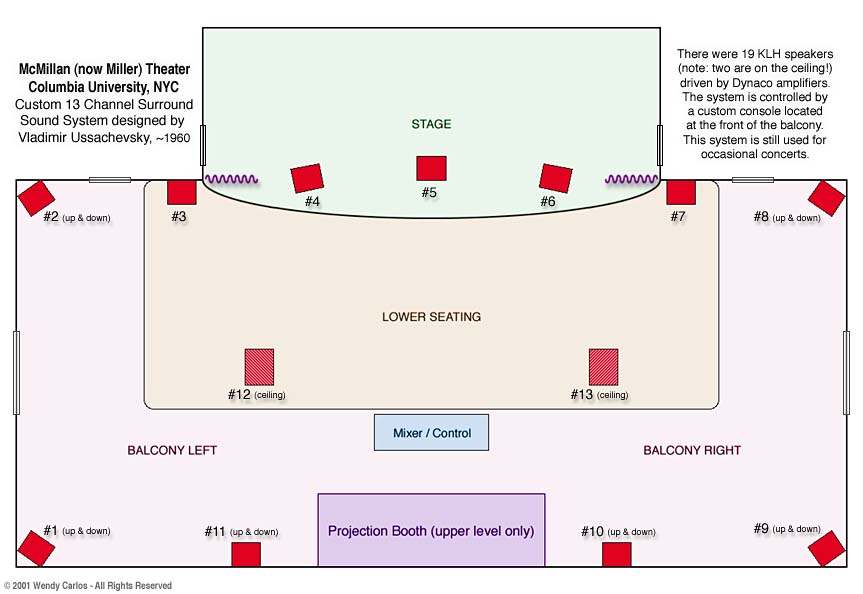
(now Miller) Theater's 13-Channel Surround
System
One
of those "toys" was not so much a device as it was an idea:
multi channel surround sound. As the luck of timing would
have it, my favorite professor, composer Vladimir
Ussachevsky, had recently designed and installed a wonderful
new sound system in Columbia University's McMillin
Auditorium (as it was then called). The diagram above is a
plan of the auditorium, showing in red the 13 speaker
channels that had been mounted and wired into a unique
installation. I still drool about the wonders one could
produce at large scale in the new field of multidirectional
audio. There are actually 19 speakers, as the balcony
interfered with producing sound at both levels from once
source apiece. So channels 1, 2, 8, 9, 10 and 11 required
two speakers each, one upstairs, the other down (which are
superimposed in this plan view). The rest are single
speakers per channel. There are also two, #12 and #13, that
were mounted up on the ceiling, facing down! The KLH
loudspeakers for channels 4, 5, and 6 were stored backstage,
and had to be brought out when needed, then positioned as
shown (connectors were nearby).
One
oversight: there should have been two more, above the exit
doors (mid-wall between #1 and 2, and also #8 and 9), at the
exact sides. Live and learn.
It was all fed from a
small room located near the upper speaker 1, which contained
sturdy metal shelving with an appropriately large number of
Dynaco power amps, a Stereo-70 for the double-spkr channels,
Mono-60's for the rest (got pretty hot in there!). Tie-lines
led down to the small electronic music studio, Room 106, in
which I composed most of my electronic music as a student
(it's now used as an office). The studio contained 5 to 8
Ampex tape machines at any one time, the outputs of which
could be fed out to the hall's system. I continued my
experimentation with surround sound, finding out what worked
as planned, and the many more ideas that simply didn't work.
A good "woodshedding experience", I learned a lot, and had a
lot of fun with it, as you might imagine!
|
 (Top
of the Page)
(Top
of the Page)
|
Nomenclature
and Full 7.2 Monitoring
Since
the 60's I've been using four or more channels on the
mixdowns of most of my performances and compositions. It's
been a life's desire to get some of this surround music into
the hands of music listeners. And that may very well be
happening soon. I also discover I've accumulated quite a few
"barnacles on the hull" from working in multichannel sound
all these decades. I'd like to scrape some of these off onto
the next generation to figure out what the $%#* to do with
some of them! That was the major motivation for creating
this web location. We'll be referring to speaker
arrangements (very important, that) and the several output
channels a lot on these pages. So let's show the
near-standard labels we'll be using. Here's the same image
at the top, smaller and with labels in red pasted over the
front of each speaker. The two subwoofers are down below
this view, on the studio floor one step below the level of
this shot, and so we've just positioned arrows that show
where they physically are located. There's nothing
surprising going on here, but we wanted to define our terms
clearly.
Speaker
Locations, 5.2 Channels
Actually,
this view with labels does not fully describe my studio's
monitoring setup. (Please
note: there's a good 12' between the back of the console
showing at the center bottom, and the old 45" video monitor,
the C speaker on top, right in between LF and RF. This
Cinerama-like WA view "squishes" that distance together,
while it also slightly exaggerates the space between LS and
LF, RS and RF.) There
are four more speakers that are not seen in this angle,
driven by another two channels of amplification. These are
located to the rear on both sides of the mixing space, where
they form a blurry impression of diffuse information behind
you and to the sides, surround channel information. I've
been using some modest Pinnacle speakers and a small stereo
amp for this job, as all surround information of this kind
is deliberately narrower, in frequency range and dynamics,
than what the other channels reproduce. For DVD or LaserDisk
playback, the "rear" information from either Dolby Surround
or discrete 5.1 tracks is fed to these channels, as well as
some mixed to LS and RS.
But for music mixing,
these small rear speakers are driven by auxillary channels,
usually ambience and antiphonal parts, or processed
reverberation and echo effects. When used, the extra
channels raise the total channel count to 7.2. That creates
a very impressive soundfield, you bet, and regularly
astonishes visitors here who've never heard that many
channels before! Since 7.2 is really just an extension of
5.1, we'll handle the latter on this web page. Just bear in
mind that it's likely at one time or another that you may
encounter another two or more channels, and that these fully
"behind you" channels are not as important as the other five
plus. You can create a similar directionality by
manipulations of the signals fed to the primary five
surround channels.
There are also cinema
systems in which the additional two channels of 7.1 or 7.2
are used as screen speakers, much as the Stereophonic Sound
for Cinerama and (70 mm) Todd/AO were developed in the 50's.
Here the new channels are added to the front, at the
screen's mid-left ("left-center") and mid-right
("right-center"), forming: L-LC-C-RC-R.
In these cases the surround info is generally the same LS/RS
pair as in 5.1 Surround (or Todd/AO's plain mono surround),
reproduced over side and/or rear "house" speakers. There
have also been films made with a Dolby-matrix encoded
Center-rear channel. That's just a quasi-channel derived
using what we're calling the LS/RS stereo pair, and
represents a pretty modest overall addition,
IF
you've already gotten the rest of the channels
optimized.
When I was working on
the six-channel sound mix for my score to Disney's
TRON,
I had to cheat a little, and used the system as you see it
below while sitting back further than usual to check
balances. That allowed the five main Klipsch speakers to
monitor all five screen channels, while several other rented
speakers served as rear surround channel monitors. Later I
added the four small Pinnacles for that less-critical task.
You can do the same thing if you encounter a need to mix to
five screen channels by moving the side speakers inwards
towards the front, or by relocating your seating position
backwards a few feet to check balances. BTW -- it sounds
wonderful even even if you don't move back, a really
stunning WIDE sound! That will collapse to screen width in a
theater, of course...
In a good theater you
can expect many speakers to be used for the surrounds,
distributed about the auditorium's side and rear walls, even
(bad idea) the ceiling! Dolby recommends many speakers to
create an even "omniphonic" distribution of surround
information, most helpful when there's only a single
channel, as the LCRS of the Dolby Stereo matrix makes
available. With the stereo surrounds of our latest discrete
digital audio you won't need so much non-directional
diffusion. But two additional screen speakers can be
marvelously effective. If done properly with a really
BIG
screen, L-LC-C-RC-R
provides precise images from the screen, more subtlety of
position, and is less affected by where you sit. Given that
screens have shrunk continuously since the mid-60's
(multiscreen multiplex mania) the distinctions are probably
lost. Mixing all dialog and most screen effects in mono to
the center has done even greater disservice to film
stereophony, IMHO.
Speaker
Locations, All 7.2 Channels
Above
you'll see the full 7.2 channels, in an imaginary overhead
view (that
"burnt orange thing" in the center is my actual studio
chair), of an idealized
studio similar to the one shown in the photos above.
Gradually we're going to work backwards, going downwards in
complexity and number of channels, until we reach classic
quadraphonic sound (and a couple of amusing variations), and
the best way to configure THAT 30 year old system. There's
really nothing new in the idea of creating music albums and
film soundtracks on multichannels, certainly not since
Disney's 1940 breakthrough animated feature,
Fantasia.
This film pioneered the idea of surround sound
("Fantasound," no less) and stereophony with a six channel
auditorium presentation using four optical tracks (three of
audio, the fourth was for front/rear steering). Credit
William Garity for most of the engineering, the same
excellent engineer who helped design their legendary
multiplane animation camera. Our tools have become a lot
more sophisticated and easier to use since then. Audio
quality is remarkably better as well, nearing the
theoretical maximums for human hearing and physical
acoustics. It's how we'll use them that will determine their
success in the marketplace, or not, like the quad boom and
bust of the early 70's. It's up to us.
This is the place to
mention, for those interested, what speakers are being shown
above. I became very attached to the Klipschorns when I was
in college. My music professor, Ron Nelson, had a pair of
them, with a central non-corner version in the middle, a
common method of using Paul W. Klipsch's horn-type speakers.
If you put one in each corner in many cases they would be
more than 90 degrees apart. The derived center speaker
helped to fill this gap somewhat. Anyway, Rachel Elkind and
I tried two horn versions in the brownstone studio when we
first move into there. Unfortunately, with the shape of the
room the corner placements were really impractical. That
would have positioned them either behind us, or very far
away in front. The dealer suggested we try the newer
"Cornwall" type (yas
-- that Klipsch model name means you can "use them in a
corner or along a wall" -- no
comment!). We made
careful comparisons for several weeks.
What we learned is that
if you made up a 3 dB loss for the Cornwalls, and then did
not exceed their already hefty maximum excursion, the sound
was nearly exactly alike between the corner horns and these
compromise versions. We were going to have four channels, so
loudness was no worry at all, not with such high-efficiency
speakers that 2 watts would fill a room! Anyway, I got
attached, as I said, to these venerable designs, and aside
from a few upgrades we made later, have used them ever
since, a reliable yardstick I can trust for all my work.
The lowest octave,
though, was always a bit weak with the Cornwalls. That was
the only other tradeoff. For years I tried small equalizers
in the monitor loops to "correct" for this. But at the time
Jim Jensen at Sterling Sound did his usual fine job cutting
my Beauty
in the Beast LP
masters I found a much better answer: "Say, what kind of low
end speakers are those, Jim?" Velodyne Subwoofers? --
Yowsah! These are active feedback, servo-corrected speakers.
I could spend a whole page singing their praises. Simply the
only game in town, far as I'm concerned. The servo feedback
corrects any and all errors. If only this trick worked above
a certain frequency (around 300 Hz), all speakers could be
near-perfect. Alas, it doesn't, as the piston-like action of
the deep bass motion gives way to more complex vibrational
modes, and no one feedback spot can correct for the whole
cone. Oh, well, where it does work, why not go for it?
You'll read below that
I had to decide between one 15" Subwoof, or two 12" units.
This was settled by trying out both carefully with a lot of
my own program material. Then the store allowed me to try it
here, and there was no argument. The servo made both sizes
very very similar in sound. The large size was slightly
louder. But two 12's were ever better, and there was
actually some directionality gained. So you'll see above and
just below the setup the way I have it, with
SWL
and SWR
located midway between the LS-LF,
and RF-RS
pairs. Works great!
This
is also a good time to apologize if I've overlooked
someone's favorite surround sound configuration or idea in
this very incomplete essay. Every opinion herein rests on
several reasonable experiments and follow-ups carried out
over a lifetime. That certainly in no way implies any pose
of "infallibility." But at least what errors or missing
concepts will be found here ought be in the "second and
third orders of subtlety." And I encourage each of you to
try things out, discover like I've discovered, what
actually works for ear, and what is only visual
chauvinism at work again in audio -- where it sure
doesn't belong. That's why I now have to turn a skeptical
eye on many of the sillier ideas being hyped as "fact."
Factoids" is more like it, or Urban Legends (question: are
there any suburban legends? How about rural?). For
myself, I'll stick with what's presented here, at least
until something better comes along, the old scientific
method: zeroing in very slowly on what's
very probably true...
|
(Top
of the Page)
The
Main 5.2 Channels
Ideal
Surround Speaker Placement -- 5.2
Channels
Fine,
let's for the time being forget about those extra two
channels. Here's the above view of our idealized monitoring
system. The main speakers, LS, LF, RF, and RS, are
equidistant from the listener and positioned at 60 degree
separations. LF and RF are bisected by C, which can be a
slightly smaller speaker from the same family of speakers,
since the bass frequencies are often routed to the bigger
speakers. But that point becomes moot when you have
subwoofers. In this case I made a trade off for two smaller
subwoofers instead of one larger one. With careful A/B
comparisons I learned that the bass was nearly the same when
the two smaller units were working together as a team as
with the single larger unit. But there was, contrary to what
I had read, a small amount of additional directionality
present with the two subwoofs compared to one. Yes, on
steady tones and those with slower attacks you heard little
difference. But on transient waves, hard attacks,
dynamically changing signals, you began to perceive a small
amount of stereo effect with the two, SWL
and SWR,
as shown above. I went with that arrangement, you may prefer
the other choice, while the cost is similar.
Modified
Front Speaker Placement -- 5.2 Channels
I've
seen setups more like the one above. What's different from
the view just above is that the LF
and RF
speakers have been rotated not to be so toe-in as before,
and the center speaker has been brought slightly closer in,
more as many three channel monitors are located in mixing
theaters and even small home theaters. It's not a big
change, and is one we'll pick up again below. If the
listening room is not as deep as it is wide, these mild
repositionings will be appreciated. The sound will not be
greatly affected at all, unless you can compare the two
setups one immediately after the other. Then you may hear a
slight reduction of the in between imaging. But it won't be
any worse than when you listen to two-channel stereo from
slightly off the exact center spot. It's not going to
destroy the surround sound field, but I bring it up as it
has become somewhat common.
Symmetrical
Surround Plan -- 5.2 Channels
On
the other hand, there is also good reason for making the
opposite modification of the front channels, like the
symmetric plan above. The 180 degree surround arc of sound
has been nearly divided into four equal angles, five
discrete channels of sound, plus stereo subwoofers. My
personal experience suggests that instead of going with the
mathematically exact division, yielding all angles of 45
degrees, this version is slightly better perceptually, with
40 and 50 degree angle pairs. It's probably splitting hairs,
but try both and see if you don't agree. We have a slightly
more acute perception of angular displacement of sound
positions when both ears are nearly balanced, facing a
central sound source in front. (It
tends to follow a cosine curve function in front of us, with
a maximum acuity at zero degrees straight ahead, falling off
towards the sides. Behind us our external ears reduce the
absolute value of this function by about 50% or more.)
The above plan
positions the LF
and RF
channels somewhat closer together, nearer to
C,
favoring that most sensitive area. This setup obviously
requires a good, active center channel. Here I've shown the
same smaller C
speaker as before. The subwoofers take care of all the bass
frequencies you could stand, so that's not much of a
compromise. Notice that for monitoring just four channels of
"quadraphonic" material, the missing C channel would leave
an impossible "hole in the middle" between
LF
and RF,
if the above configuration were chosen (40 + 40 = 80 degrees
apart -- yikes!). If you have to check on a lot of 4 channel
material you'd be better off with the first or second layout
above. But for 5.2 channels of music, this one's unbeatable
-- have
yourself a ball!
|
(Top
of the Page)
Digression
I -- Classic Blunders to Avoid
The
Worst Quadraphonic Setup -- 4 Channels
Sometimes
the eye can fool the ear into thinking things are fine and
jolly, when they ain't. We can all count the four corners of
a typical room (har-dee-har, my studio is semi- trapezoidal,
and has SIX corners!) or studio. When the first quadraphonic
sound was being introduced in the early 70's guess where
they put the speakers (you've had enough hints)? Yup, just
like the image above, one for one. It also seemed like a
nice, democratically evenhanded approach, we have 360
degrees to split up, let's see now, 4 goes into 360... And
we get this "classic" setup in name only. It's a complete
blunder of the job, about as bad an arrangement for surround
sound with four channels as one could devise. If there is
but one lesson to be learned via this introduction, it's the
graphic one visualized above.
Take a look with your
foolish eyes once again. 90 degrees is a pretty wide angle
to try to fill with two speakers. Even from the equidistant
"sweet spot" as the seat above is located, you will find
images tend to vanish when they are midway between the
speakers. You have another classic going on here,
stereophonically speaking, a "hole in the middle." Add the
two other channels and what you get is FOUR holes in the
middle. You end up with sound that can only be precisely
heard from but four spots. Everywhere else is an omniphonic
spread of hard-to-point-to vagueness. It gets worse. Try
listening to a normal stereo system (about 45 to 60 degree
speaker separation) with your back to the speakers. Hmm...
the stereo sort of collapses inwards, doesn't it? I'm not
trying to lay any dogma on you. These are simple matters to
try out with your own ears, as is all the stuff on this
page. We all were surprised to learn how things are not so
obvious as we first think they'll be.
And it gets worse
again. When you face forward, you can hear any speaker
located in front of you, and follow it as it moves to the
exact side, either side, whereupon it will sound like it's
moving back in towards the middle again, but without the
same precision when the speaker moves behind your head.
Again it works on both sides the same way. All stereo relies
on the fact that our ears will hear "ghosted" virtual images
of sounds located between any no too widely separated
loudspeakers, if the distances, phases, and sound levels are
correctly adjusted. But aside from some very clever tricks
heard from exacting positions and setups, you normally won't
hear sounds come from outside of a pair of speakers.
The result is that you
can image sounds rather well in central locations, with
speakers moved to each side a bit, but those speakers set
the maximum width you'll be able to reproduce well. Think
about those two speakers behind you in the view above. Their
sounds are towards the center, just like the front pair. So
there's nothing that sounds like it's coming from the sides.
The only way to fill in the side "hole" is by locating a
speaker there, one on each side works splendidly. After you
have normal stereo there is no better place to locate the
next two channels than exactly to either side of you. That
also works when you add a 5th channel, as the latest
surround sound systems do. Like this:
The
Worst Surround Setup -- 5 Channels
This
view is of the worst possible use of five channels. Now one
of the black holes in the middle is filled in, leaving just
three of them. The sounds up front are fine, wide and very
decently positioned. There are no sound to the sides of
those speakers, though. Everything comes mainly from within
this right angle of two 45 degree sectors. What about the
rear channels? Well, they will be heard, of course, but the
stereo will be poor compared with that in front. Not only is
there no central rear speaker, but the back positions are,
like before when you tried this yourself, not definitely
locatable. Any poor stereo effect is narrowed when it's
completely behind us. Those two channels are being wasted,
just as they were with most quad sound in the 70's. Little
wonder an honest public might be less than impressed, when
confronted with the truth of their own two ears.
The first four channel
setup I had, when my studio was in the brownstone, as shown
in many phonos on our website, was exactly as the first of
these two views shows you. That was folly on my part,
because I should have known better, having made many four
channel recordings years before with that custom Viking tape
deck. I tried placing microphones in that same shape, then
the speakers when I played the tapes back. I tried all of
them way up in front in various shapes. I tried a "diamond",
with one channel up in front, one directly in back, and one
on each side. That was much better, but the holes in the
middle were irritating, and I was never sure if a certain
sound was exactly in front of me, or exactly behind me. Once
more I beg you to try this all out for yourself. You can
certainly record two channels at a time, and see what
happens when the two speakers are center front and center
back, then again one on each side, and so forth for each
possible pairing. Play the recording in the dark or with
your eyes closed. Invite friends and other sophisticated
audio buffs to listen with you and compare notes.
Again, you don't have
to take my word on this issue. David Greissinger, the
brilliant head designer for Lexicon for more than 25 years
wrote several scientifically researched papers for the AES
(Audio Engineering Society), the AAS (American Acoustical
Society), and others in the 80's and more currently. He
stumbled upon the very same discoveries which Rachel and I
had back in the early 70's (check
out our new bibliography
at the end of these pages).
Our lesson was painfully learned and was independently
reproducible, to boot. We had to rehire the same strong
electrician / handyman to return and relocate the rear two
speakers, positioning them up at the
sides
(a
compromise, speakers that high up can leak over the head
slightly to the opposite ear),
as you can see in the wider photos
of the brownstone studio.
The mistake was too painful to live with, and we had to
admit it and go with what our ears were telling us. When I
moved into here I didn't make the same mistake. Did it even
better, as I have a lot wider space. You can see how the
channels are located way above. In an arc, 180 degrees wide,
like those old Cinerama Screens. Then you more or less split
the angle into three parts, so the channels are located at
roughly 60 degree intervals. Or use the more
symmetrical arrangement
above. What's that old line?: "Try it, you'll like
it!"
|
(Top
of the Page)
Digression
II -- Listening Test to Try yourself
Standard
Stereo, both speakers in front of you
There's
something most valuable I learned during a valiant failure
to become a Physicist. Well, more than one, like keeping a
wary, skeptical eye out for deception, or the even more
common, self deception. But a lesson that holds in any field
at all is a willingness to be proven wrong. You are much
more likely to discover crumbs of truth if you don't
prejudge what you expect to find too closely, relying
instead on reality-checks and experimental tests. Unlike a
few sites I've seen that preach to the bleachers, I want you
to check out what I'm trying to describe here, not merely
take my word on it. Beware the newest Great Prophets who
claim possession of "the one true path." All of these ideas
here contain a margin for error, a tolerance, and have been
verified experimentally, not idle philosophy. You can alter
things to a degree away from what's here, before things will
weaken or fall apart. And you may discover even more refined
ways to handle each situation.
A very modest test is
shown in this digression. You ought be able to try it
without any special equipment or setup, at home or in the
studio. One of the key reasons that many of the original
suggestions about Quadraphonic Sound in the '70's failed to
live up to their hype could have easily been found by a
curious person who was unwilling to go along with the party
line. Consider the four speakers, one per corner, concept
given in the previous digression. How does sound from the
front two channels get perceived, and is this much different
from the rear two channels of "obvious quad"? Try one
pairing at a time. Pick a few good CD's that exhibit
excellent sound, separation, and imaging/ambience. First sit
as shown just above, the usual way, centered in the "sweet
spot". Okay, note what you hear, essentially all the sound
in front. Now swing your chair around, so you're facing away
from the speakers, like this:
Face
the other way -- both speakers behind you
(well,
the chair is rotated around)
This
view is a pretty accurate metaphor for what you'll hear when
you rotate your chair around by 180 degrees. All the sound
now is located behind you. Keep the same music playing as
above, listen, then switch the way you face back and forth
several times to compare the differences you hear. The
speakers won't really edge closer together when you face
away, nor ought the directional information become oddly
blurred, but that's certainly the way it sounds! I was
rather shocked by this test when someone suggested it to me.
We had experienced the same problems with the crummy initial
layout we'd made in the brownstone studio, and knew
something fundamental was going on. But this elegant A/B
comparison is such a simple way to demonstrate the
principle. The way our ears are constructed we "funnel-in"
sounds easily from in front and sides with our built-in "ear
trumpets." Whatever comes from behind is masked by those
same bio-trumpets, robbing crucial mid and high frequencies
especially, the stuff of directionality.
Ever watch a cat rotate
its outer ears while listening intently? Theirs are even
larger proportionally than ours, and the horn effect must be
highly noticeable. They also have better muscle control over
them than we do, so they can redirect the aiming points to a
large extent. It can't be done simultaneously, but watch
them listen to a repeated, continuing sound, and how quickly
they are able to zero in on the exact direction. They can
adjust to, and adapt better than us in front/read
comparisons, so would undoubtedly come up with a
significantly different plan for Feline Surround
Sound...
But we're interested in
an optimum plan or two for Human Surround Sound. Since the
back of our heads is not nearly as sensitive to sound
directionality and nuance (not to mention a poorer frequency
response, and unfortunate interference as sounds move away
from the rear of one ear towards the rear of the other), we
ought not "waste" too much effort trying to obtain what we
can't: a uniform sound field. That's where so many surround
concepts fall down, assuming we humans can hear in 360
degrees and follow it all accurately.
|
©
Copyright 2001 Wendy Carlos -- All Rights
Reserved.
(Top
of the Page)
 Back to the Wendy Carlos Home Page




srnd.jpg)
srnd.jpg)
srnd.jpg)
srnd.jpg)
srnd.jpg)
 Go
on to Pt. II
Go
on to Pt. II
srnd.jpg)
srnd.jpg)
srnd.jpg)